I wouldn't normally link to the DLC website. I think they are really the problem with the Democratic Party. Beltway Demo's who try to play it both ways. But Gov. Vilsack makes some good points about government:
...our national community has been diminished by the inadequate and sometimes incompetent response of one of its essential elements, our national government.
All too often, conservative ideologues who now honeycomb the halls of our great public buildings in Washington have promoted the idea that government is an alien institution that illegitimately confiscates and redistributes resources to no great purpose other than sustaining our armed forces at the absolute minimum of effectiveness. These ideologues have viewed government, even the federal government they control from top to bottom, as a necessary evil to be tolerated, an obstacle to be overcome and undermined, a "beast:" to be starved. And worse yet, when their plans to dismantle government are thwarted, they tend, not surprisingly, to view federal agencies as little more than a vast patronage opportunity for fellow-partisans who don't much believe in the missions they are supposedly pledged to perform.
DLC: Statement of DLC Chairman Gov. Tom Vilsack
Friday, September 16, 2005


Government is bad, isn't it?
Government is bad, isn't it?
Reza Dibadj
The gut-wrenching pictures from the
To these meta-issues, I add an important contributing factor: Our public infrastructure is compromised, making it more vulnerable to disaster. The spectacular failure of the levee system in
The problem, of course, runs much deeper than isolated crises. Consider that in its 2005 Report Card for
Contrast this assessment with
Of course, pundits who typically clamor for smaller government -- uncharacteristically quiet, at least for a few days -- will no doubt bristle at this suggestion as immediate dangers pass. They will point to the fact that infrastructure decisions come down to a cost-benefit analysis. But cost-benefit analysis, at least as practiced today, typically suffers from three fundamental flaws. First, cost is much easier to measure than benefit; as a consequence, new research is showing that benefits are undervalued, leading to underinvestment. (How to value accurately a human life, clean air or clean water?) Second, despite a veneer of certainty, such analyses are typically done by politicians and economists, who too often bring ideological bias. They are best left to scientists and engineers. It is no coincidence, for instance, that technical experts have been issuing warnings regarding the levee system in
Beneath the veneer of seemingly elegant cost-benefit analysis, the usual trump card employed by those opposed to upgrading infrastructure is that it is simply too expensive. To this, the response should be a purposeful "compared to what?" If we need to pay to be secure, so be it. After all, we are not a nation that cowers from challenges. Resources have been mustered for every problem
Intellectuals are not immune: Many want to "outsource government" and believe democratic discourse can simply be mediated via private-market transactions. Such laissez-faire theories stumble when they face public goods such as infrastructure. In economic jargon, these goods have "positive externalities": Because everyone benefits, no one individually has an incentive to pay for them. Think parks, national defense, roads, highways and, yes, levees. Private markets do not have incentives to produce these goods. Without government's coercive powers, everyone wants a free ride.
Needless to say, however, that investing in public goods is decidedly out of vogue in an era that exults the private. Why should we worry about mundane things such as public roads and sewers when our culture tells us to aspire to personal makeovers, SUVs and gated mansions? After all, according to the conventional wisdom, we need to get government off our backs so we can get on with our lives.
The stunning irony in all of this is that government is considered bad, except when we need it. Tragedies such as the Hurricane Katrina aftermath at least offer us a precious opportunity to re-examine our assumptions. Of course, improving our infrastructure is not a panacea. But it would be a good place to start.
Bush: A Polluter's Feast
Politics and money, politics and money. They only things the Bushites care about.
RollingStone.com: A Polluter's Feast : Politics
RollingStone.com: A Polluter's Feast : Politics
Thursday, September 15, 2005
Bill Maher on Shrub
"Mr. President, this job can't be fun for you any more. There's no more money to spend--you used up all of that. You can't start another war because you used up the army. And now, darn the luck, the rest of your term has become the Bush family nightmare: helping poor people. Listen to your Mom. The cupboard's bare, the credit cards maxed out. No one's speaking to you. Mission accomplished.
"Now it's time to do what you've always done best: lose interest and walk away. Like you did with your military service and the oil company and the baseball team. It's time. Time to move on and try the next fantasy job. How about cowboy or space man? Now I know what you're saying: there's so many other things that you as President could involve yourself in. Please don't. I know, I know. There's a lot left to do. There's a war with Venezuela. Eliminating the sales tax on yachts. Turning the space program over to the church. And Social Security to Fannie Mae. Giving embryos the vote.
"But, Sir, none of that is going to happen now. Why? Because you govern like Billy Joel drives. You've performed so poorly I'm surprised that you haven't given yourself a medal. You're a catastrophe that walks like a man. Herbert Hoover was a shitty president, but even he never conceded an entire city to rising water and snakes.
"On your watch, we've lost almost all of our allies, the surplus, four airliners, two trade centers, a piece of the Pentagon and the City of New Orleans. Maybe you're just not lucky. I'm not saying you don't love this country. I'm just wondering how much worse it could be if you were on the other side.
"So, yes, God does speak to you. What he is saying is: 'Take a hint.' "
"Now it's time to do what you've always done best: lose interest and walk away. Like you did with your military service and the oil company and the baseball team. It's time. Time to move on and try the next fantasy job. How about cowboy or space man? Now I know what you're saying: there's so many other things that you as President could involve yourself in. Please don't. I know, I know. There's a lot left to do. There's a war with Venezuela. Eliminating the sales tax on yachts. Turning the space program over to the church. And Social Security to Fannie Mae. Giving embryos the vote.
"But, Sir, none of that is going to happen now. Why? Because you govern like Billy Joel drives. You've performed so poorly I'm surprised that you haven't given yourself a medal. You're a catastrophe that walks like a man. Herbert Hoover was a shitty president, but even he never conceded an entire city to rising water and snakes.
"On your watch, we've lost almost all of our allies, the surplus, four airliners, two trade centers, a piece of the Pentagon and the City of New Orleans. Maybe you're just not lucky. I'm not saying you don't love this country. I'm just wondering how much worse it could be if you were on the other side.
"So, yes, God does speak to you. What he is saying is: 'Take a hint.' "
'Diebold System One of Greatest Threats Democracy Has Ever Known'
Don't think the Republicans are stealing elections? Well, get your head out of your ass. And if your state is using Diebold, use a paper absentee ballot and demand a change.
'Diebold System One of Greatest Threats Democracy Has Ever Known'
THE BRAD BLOG: "* EXCLUSIVE! * A DIEBOLD INSIDER SPEAKS!"
'Diebold System One of Greatest Threats Democracy Has Ever Known'
THE BRAD BLOG: "* EXCLUSIVE! * A DIEBOLD INSIDER SPEAKS!"
Wednesday, September 14, 2005
I'm not Kidding....
This picture was snapped by REUTERS/Rick Wilking today at the U.N. SECURITY COUNCIL meeting:

Here's a closer look:
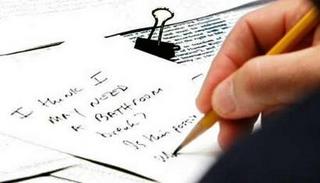
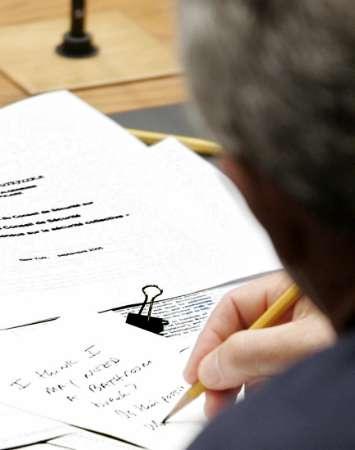
Here's a closer look:

Guess who's writing this "I need to go potty" note to C. Rice? That's right, President Bush. Could this moron not remember to go before he started the goddamn meeting for the U.N. SECURITY COUNCIL. You figure this meeting might be of some importance. He's a petulant, disconnected, child who doesn't need to be running this country. RESIGN, BUSH!
Here is Reuters caption for the picture:
U.S. President George W. Bush write s a note to Secretary of State Condoleezza Rice during a Security Council meeting at the 2005 World Summit and 60th General Assembly of the United Nations in New York September 14, 2005. World leaders are exploring ways to revitalize the United Nations at a summit on Wednesday but their blueprint falls short of Secretary-General Kofi Annan's vision of freedom from want, persecution and war. REUTERS/Rick Wilking
Here is Reuters caption for the picture:
U.S. President George W. Bush write s a note to Secretary of State Condoleezza Rice during a Security Council meeting at the 2005 World Summit and 60th General Assembly of the United Nations in New York September 14, 2005. World leaders are exploring ways to revitalize the United Nations at a summit on Wednesday but their blueprint falls short of Secretary-General Kofi Annan's vision of freedom from want, persecution and war. REUTERS/Rick Wilking
Right Wing Religious Wackos
These insane Christian morons will try to hijack anthing to promote their crazy-ass agenda. Jeebus!
Passion of the Penguins
UPDATE:
Fugere makes a great observation in the comments below. Give it a read then click on the link for his backing research:
Penguin Pride!
Passion of the Penguins
UPDATE:
Fugere makes a great observation in the comments below. Give it a read then click on the link for his backing research:
Penguin Pride!
Tuesday, September 13, 2005
End of the Bush Era
Amen, brother, Amen.
Highlights of the article:
...leadership is detached and self-indulgent...
...more tax cuts for his wealthiest supporters...
...invoked our national anger over terrorism to win support for a war in Iraq...
The source of Bush's political success was his claim that he could protect Americans. Leadership, strength and security were Bush's calling cards. Over the past two weeks, they were lost in the surging waters of New Orleans.
And so much more.... Give it a read.
End of the Bush Era
Highlights of the article:
...leadership is detached and self-indulgent...
...more tax cuts for his wealthiest supporters...
...invoked our national anger over terrorism to win support for a war in Iraq...
The source of Bush's political success was his claim that he could protect Americans. Leadership, strength and security were Bush's calling cards. Over the past two weeks, they were lost in the surging waters of New Orleans.
And so much more.... Give it a read.
End of the Bush Era
Right-Wing Myths About Katrina, Debunked
If you need to know how to respond to the constant flow of bullshit from the Republicans click below.
Think Progress � Right-Wing Myths About Katrina, Debunked
Think Progress � Right-Wing Myths About Katrina, Debunked
The Complete Idiot
If you've never checked out Slate's "Complete Bushisms", you should. It really details how utterly incompetent the man is.
The Complete Bushisms - Updated frequently. By Jacob Weisberg
The Complete Bushisms - Updated frequently. By Jacob Weisberg
Subscribe to:
Posts (Atom)



